

Growth guide
AI searches find restaurants and agents are placing orders.
Global spend through AI assistants could reach $3.5 trillion by 2031. Be the restaurant they pick, and every order lands direct, with no commission.
 Tim Frostick13 October 20264 min read

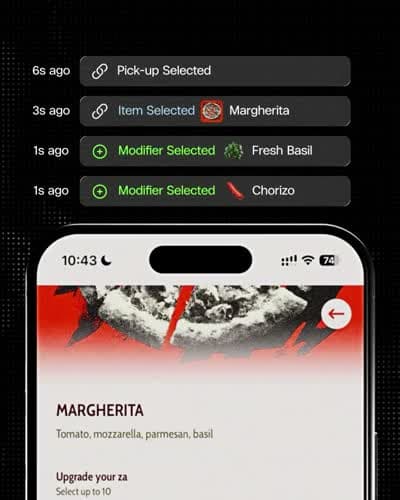
When asked, AI assistants like ChatGPT and Google find restaurants, read menus and start an order. The guest still decides what they want, but the assistant decides where it comes from.
What is agentic ordering?
Ask an assistant for dinner and it doesn't just suggest a restaurant. It reads the menu, picks the dishes and gets the order ready. The guest checks it and pays.
- 1990s: the takeaway menu"Where's that menu from the drawer?"The guest phones the order in.
- 2000s: web search"Best pizza near me"A list of links. The guest compares menus and orders.
- 2013: marketplaces"Pizza delivered to me"The app decides which brands are visible, takes up to 30% commission on every order, and keeps the guest data.
- 2023: AI search"Veggie pizza near me, under £15?"The assistant names three or four places. The guest picks one.
- Now: AI ordering"Order my usual veggie pizza for 7pm"The assistant picks the restaurant and fills the basket. The guest taps to pay.
What it means
Predicted global spend through AI assistants by 2031.
Source: Juniper Research, Agentic Commerce Market 2026-2031Of online shopping in Europe could be done by AI assistants by 2030.
Source: PwC Strategy&UK diners already use AI to choose where to eat. In London it's 39%.
Source: ZonalWhy it matters for restaurants
AI assistants recommend the restaurants whose menus they can read and understand. Great food isn't enough on its own: the clearest menu wins the order.
- It only recommends a few. An assistant suggests three to five restaurants. If you're not on that shortlist, you don't get the order.
- It needs the details. If your menu doesn't say what's in a dish, how spicy it is or whether it's vegan, the assistant recommends someone whose menu does.
- Early movers get picked. Most restaurants haven't updated their menus yet. Complete menus get recommended first.
- Missing details go to the marketplaces. If your own menu is thin, the assistant uses your marketplace listing instead, and the order goes through the app, with commission.
A guest asks for a gluten-free dinner. You have the perfect dish, but your menu doesn't tag it as gluten-free, so the assistant recommends someone else.
Seven fixes: get found, then get ordered
No technical skills needed, and every fix helps human guests too.
- Name every dish clearly.
"Chef's special" tells an assistant nothing. "Chicken katsu curry" tells it everything. Keep your brand personality, but make it obvious what the dish is.
Open MenusMenu structure guide - Write a description for every dish.
Say what's in it, how it's cooked, how spicy it is and how big it is. One or two lines is enough.
Open MenusWriting descriptions - Add allergens and dietary tags.
Vegan, vegetarian, gluten-free and the main allergens. These match the questions guests ask most. Only tag what your kitchen can stand behind.
Open MenusAllergen strategy - Set up extras as modifiers, not notes.
Sizes, spice levels and add-ons should be choices the guest can tick. Options written inside a description are hard for anyone to order.
Open Menus - Keep your Google listing up to date.
Google's AI leans on your listing and your reviews. Match your hours, add photos and reply to reviews every week.
Connect GoogleGoogle Business Profile guide - Make ordering direct the easy option.
Point the order button on Google to your Storekit ordering page, and allow orders for later, so an assistant can book "lunch on Friday at 12" as well as "now".
Add your ordering linkHow assistants order - Keep your hours right, including holidays.
Assistants check you're open before they suggest you. Add bank holiday and Christmas hours well ahead.
Open Stores
Already readable. Already orderable.
Every Storekit storefront is agent-ready by default, with nothing to switch on. Assistants like ChatGPT, Claude and Gemini, and personal agents like Instinct, Muse and Dots, can find your store, read your menu, check slots and build a priced basket.
- Always live. Change a price or mark a dish sold out, and assistants see it straight away.
- The guest pays on your page. Checkout happens on your Storekit ordering page. You keep the guest, the data and the margin.
- You see where orders come from. Orders that start in an assistant are tagged as AI agent traffic.
| Built in | What it gives an assistant |
|---|---|
| llms.txt | Your menu, hours and prices as plain text. |
| MCP server | Tools to search your menu, check slots and build a basket. No key needed. |
| UCP profile | Discoverable by shopping agents. |
| robots.txt | GPTBot, ClaudeBot and other AI crawlers allowed in. |
Sources
- Juniper Research, Agentic Commerce Market 2026-2031.
- PwC Strategy&, The agentic AI revolution in retail.
- McKinsey, AI to browse, but not to buy.
- Zonal and NIQ, UK consumer research, reported by Restaurant Online, 8 October 2026.
- Uberall, Fast Food, Faster Discovery: The 2026 GEO Playbook.
Questions operators ask
Do I need to set anything up on Storekit?
No. Every Storekit storefront is readable and orderable by AI assistants out of the box. The more complete your menu, the more often you get picked.
Can an AI assistant take payment?
Not yet, on purpose. An assistant builds a priced basket, then the guest pays on your Storekit ordering page, with your checkout and your guest data.
Which assistants can read my menu?
Anything that reads the web or speaks MCP, including ChatGPT, Claude, Perplexity, Gemini and personal agents like Instinct, Muse and Dots.
How do I know it's working?
Orders that start in an assistant are tagged as AI agent traffic, and the Guest traffic report shows how often assistants read your menu.
More from the blog
Choosing an ordering system
True cost, data ownership, integrations, support, exit terms - the six checks that separate sound platforms from regret, learnt the hard way by 123,000 GloriaFood operators.
Harry Soar · 11 June 2026 · 2 min read
Read post →

Guest photos and reviews
The useful part of UGC for a restaurant is mechanical: when to ask, what you are actually allowed to repost, and which format is worth the most.
Harry Soar · 23 August 2026 · 3 min read
Read post →
Click and collect
The four settings that decide whether collection works or falls apart: lead time, slot capacity, what you do with the packaging, and the handover at the counter.
Harry Soar · 23 August 2026 · 3 min read
Read post →
Be easy to find.
Be easy to order.
Start with your menu. Every description and allergen you add is one more reason for an assistant to choose you.