
Download and Print Labels
1
Open the order
Go to Orders → Catering and click the order you want to pack.
2
Download the labels
Click Print Item Labels on the order. A PDF downloads with a label for each item quantity. For example, two of the same sandwich produce labels numbered #1 and #2. Modifiers configured to print as products also receive their own labels.
3
Check the PDF
Review the item name, order code, modifiers and any notes, allergens and ingredients. Check the printed date and storage instructions are suitable for the food you are supplying.
4
Print a test label
Open the PDF in your PDF viewer and choose the intended printer and paper size. Check the preview, then print one page before printing the whole order. Confirm that nothing is clipped and the smallest text is readable.
Example Labels
This fictional office-lunch order shows two vegetarian wraps and a chicken sandwich with a modifier and a packing note. The PDF is generated by the same label renderer used for orders; it is an example, not an editable template.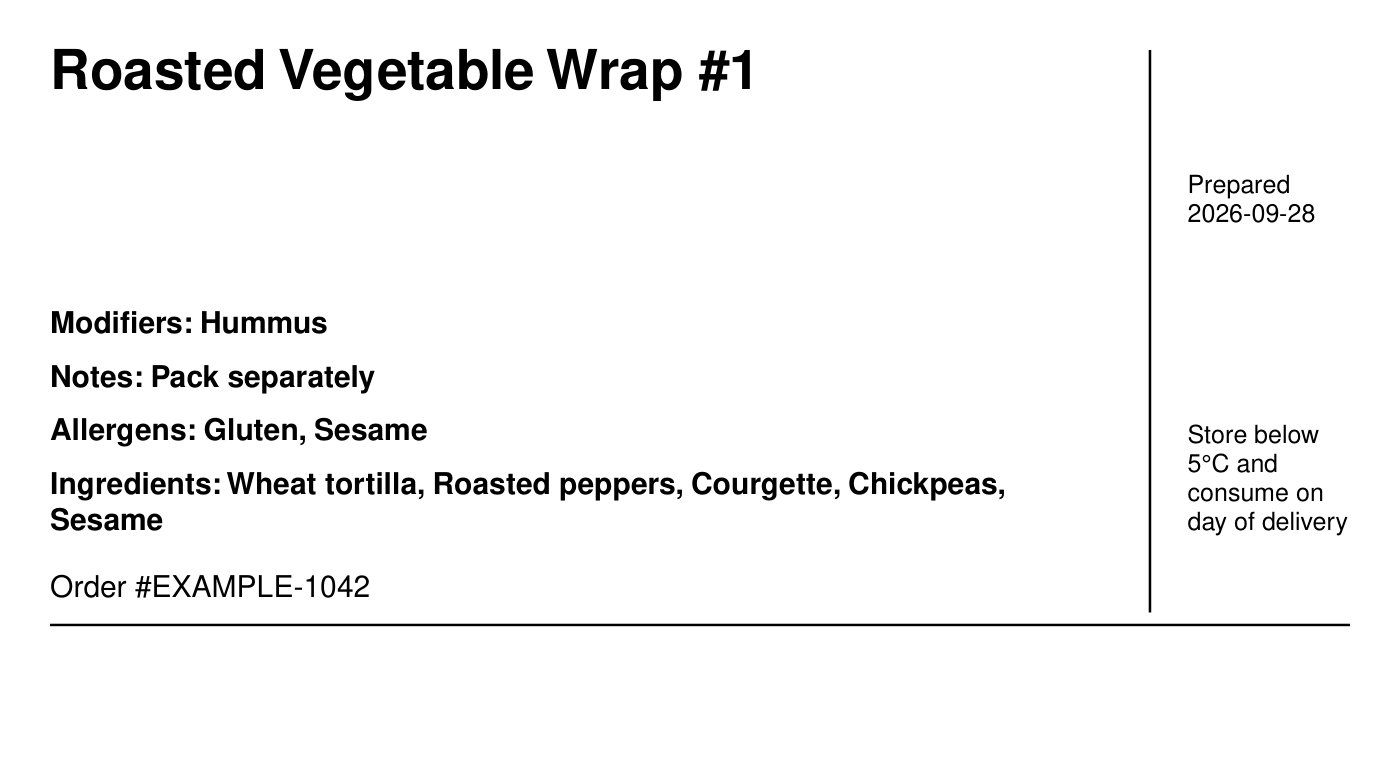
An example item label from the downloadable PDF. All food and order details are fictional.
Choosing a Label Printer
Zebra ZD230 DT is the direct-thermal model supplied for Just Eat for Business by ERS. Their bundles use 101 × 50 mm labels and offer different desktop and tablet connection options. Treat it as a model to evaluate, not a confirmed storekit-compatible purchase. The current storekit PDF pages are approximately 198 × 109 mm, which do not match that stock. Scaling, margins and text legibility need a physical print check before ordering hardware or reusing another platform’s setup.- Ask the supplier to test the example PDF with the exact printer, device and label stock you plan to use.
- Check tablet printing separately; a desktop driver or another platform’s tablet bundle does not establish compatibility with storekit.
- Do not add the Zebra under Direct Printing. That feature uses Star CloudPRNT printers for order tickets; item labels use a downloaded PDF.
Troubleshooting
The label is clipped or the text is too small
The label is clipped or the text is too small
Check the PDF page size against the selected paper size, orientation and scaling. Test one page with a long item name and food information. If it cannot be printed legibly on your stock, contact support before using it for orders.
Food information is missing
Food information is missing
Check the information saved on the item and its modifiers. Labels do not invent missing ingredients or allergens. See Tags and Allergens, then download a fresh PDF and check it before use.